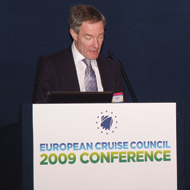
Signori
e Signore, Ladies and Gentlemen,
May
I welcome you to the third European Cruise Industry Conference. This is a particularly significant moment
for the cruise industry as we form part of the European Maritime
Day, a celebration of the maritime sector and its vital importance
to Europe as a whole.
The cruise industry is itself a major component of the
European maritime sector and is becoming an ever greater contributor
to its economic and social well-being.
When
addressing this conference last year my theme was “Europe –
the new centre of gravity of the cruise industry”.
That statement continues to hold true, and the European
cruise sector has continued to grow more quickly than its counterpart
in North America. But this year I want to emphasise in addition the resilience
of cruising and demonstrate how, through its business model, the
cruise industry remains a source of growth even in uncertain times.
Today
I am delighted to announce the launch of the 2009 edition of
the European Cruise Council’s annual report, the Contribution
of Cruise Tourism to the Economies of Europe. The report describes the economic output
of the cruise industry in Europe in 2008, and is the fourth
of its type, the first have recorded the state of the industry
in 2005. In each successive year since then cruise
has recorded significant growth, and 2008 was no different.
Since
2005, the number of passengers globally cruising each year has
grown by 12% whereas the number of Europeans cruising has grown
by 33% to 4.4 million last year, a 10% increase over 2007.
Capacity since 2005 has grown by 44%, which means that
as well as the many more Europeans cruising, record numbers
of people are coming from all over the world to cruise in Europe.
This brings huge economic benefit to the coastal regions
in particular, with the combined number of passenger embarkations
and way-port visits having exceeded 26 million, 66% more than
in 2005.
The
single most important indicator of the value of the cruise industry
to Europe is its direct expenditures. In 2008 these amounted to ¤14.2 billion,
an increase of 10% over 2007 and 71% more than our first recorded
figure in 2005. Cruise
ship building and cruise line expenditure both exceed ¤5 billion,
whilst passenger on-shore expenditures amount to almost ¤3 billion,
and cruise line employee compensation exceeds ¤1 billion.It
is particularly appropriate to announce here in Rome that Italy
has the largest cruise economy in Europe, with direct expenditures
of ¤4.3 billion, followed by Germany with ¤2.4 billion, the
United Kingdom with ¤2.3 billion and France with ¤1.4 billion. In fact every European country benefits
from the cruise industry – every member state with a coastline
enjoys cruise ship visits whilst even the landlocked states
provide manufactured goods and produce.
All these economic elements
continue their steady growth.Cruise ship building
in Europe is an incredible success story and something of which
everyone in the maritime sector should be proud.
Almost every cruise ship afloat has been built in Europe,
and in 2008 a further 20 vessels were under construction.
The current order book comprises 33 cruise ships for
delivery between now and 2012.The cruise industry
is multi-faceted. A
cruise ship requires food, beverage, fuel, chemicals and manufactured
goods and it requires port and other transportation services.
And the industry calls for a whole range of services
ranging from finance and insurance through to marketing and
retail distribution. Reflecting the growth of the industry as
a whole, these goods and services have increased by 75% since
2005.150,000 Europeans are directly employed in the
cruise industry now, compared with under
100,000 three years ago.
Most significant is that the number of European seafarers
in the cruise sector has increased by 79%, reflecting the highly
skilled marine work-force which Europe continues to offer.At
a way-port the average amount spent by a passenger ashore is
¤57, making a typical cruise call worth around ¤100,000.
A passenger at a port of embarkation injects an average
of ¤106 into the local economy, making a large ship turn-round
worth over ¤300,000. This
type of expenditure, along with associated travel to and from
the cruise contributes ¤2.7 billion to the European economy.
The total economic impact
of the cruise industry in Europe, taking together direct, indirect
and induced impacts is over ¤32 billion, similar to the industry
in North America, and 69% more than in 2005.
In 2008, the jobs of 311,000 Europeans depended on the
cruise industry, and maybe this statistic more than any other
drives home just how important the business of cruising has
become.
The
cruising business model is a very stable one, and all the while
more new ships are introduced and capacity is increased, economic
value will also increase. Our ships operate 365 days a year. A day out of service is a lost opportunity because no
matter what a passenger has paid for his ticket, he or she will
spend once on board. And
for the same reason, the most profitable way to sail a cruise
ship is to sail it full. So even if there is downward pressure
on ticket prices, the cruise industry will always deliver valuable
economic output. The only thing which would threaten this
output in Europe would be a change in regulatory conditions,
sending ships away to friendlier regimes elsewhere.
But in this positive and upbeat environment, this is
something I would prefer not to contemplate.
And the reason
I do not contemplate it is the positive relationship which is
developing here in Europe between industry and regulators.
Since the foundation of the European Cruise Council five
years ago by my esteemed colleague Pier Luigi Foschi, we have
found commissioners and parliamentarians in Brussels and elsewhere
both surprised and impressed by the story we have to tell.
We in turn have been impressed by the willingness of
regulators to take account of the unique circumstances of our
industry in lawmaking. We see a very positive collaboration developing – we
wish to play our part in the improvements which good regulation
is meant to deliver, and all we ask is that the great economic
opportunity which we provide is not lost and that we are allowed
to adapt to new laws in economically viable ways.In
this morning’s sessions we will discuss some fine examples of
collaboration, sometimes finding a beneficial solution from
diametrically opposing start-points. We are pleased with the progress made with HELCOM and other
stakeholders leading to a formal European Cruise Council protocol
over wastewater discharge in the Baltic, and delighted that
on the strength of our industry’s economic performance an EU
study into tourist facilities in ports is being undertaken.
We are making progress with Council and Parliament on
passenger rights to ensure that our unique industry isn’t unnecessarily
hampered by a “one size fits all” approach to transport. And
of course we welcome the founding of the EU Naval Force to provide
protection from piracy off Somalia and are especially pleased
to have cruise industry and military personnel working together
to minimise risk and avoid disruption of our schedules.
And
we have much work still to do together, be it debating the environmental
and economic aspects of shore-side power during port calls,
the pan-European harmonisation of terms and conditions and also
bonding schemes within the revision of the 1992 Package Travel
Regulations due next year – a true of example of better
regulation making it easier to do business, or more general
examples of restrictive practices in some member states which
even now make our Market a less than Common one.
A key issue in preserving the attraction of Europe as a great
place for cruising business is to maintain global competitiveness. It is absolutely right that Europe should
take the lead in industry best practice but this must achieved
through regulation which recognises that any shipping business
is a mobile one which can divert its assets elsewhere and as
such avoids weakening the very industries which it is intended
to support. This is of course very much a theme of the Commission’s Maritime
Strategy document 2009-2018, which we warmly welcome.Let
me give some examples likely to enter our discussions this morning.
With this year’s Copenhagen meetings in mind, we strongly
desire international agreement on market-based instruments to
moderate carbon emissions, rather than the complication of an
interim EU scheme. Regarding sulphur, we urge the Commission
not to go beyond the recently revised and already challenging
sulphur revisions in MARPOL Annex VI.
We continue to lobby for indirect tax treatment of on-board
sales of goods and services which do not make European cruising
unattractive, and we warn against European employment legislation
which makes globally uncompetitive the very workforce whose
well-being and prosperity we wish to protect.
To conclude then, the European
cruise industry is already enjoying successful collaboration
with Brussels and with Member States.
We thank Governments and the Commission for already listening
to our messages and we look forward to working closely for the
benefit of the many stakeholders in this complex industry.I
firmly believe that by working together, the European cruise
industry and the European Union can deliver economic growth
by promoting both best practice and global competitiveness.Thank
you – and I hope you find this morning’s conference a
further valuable contribution to the development of our industry.