| European
Maritime Day Plenary Session
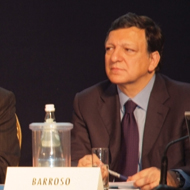
José Manuel Barroso, President of the European Commission
European Maritime Day, Rome
19 May 2009
Thriving
on an ocean of opportunities
Prime Minister,
Ministers,
Ladies and gentlemen,
We are here
today to commit ourselves to a sustainable future for the oceans
and seas, for the maritime sectors and for our coastal regions.
I am delighted that you have come in such great numbers to share
this commitment.
Europe is
a maritime continent. Half her inhabitants live less than 50km
from the sea, like here in Italy for instance, and the maritime
area under our Member States' jurisdiction is greater than their
territorial land mass! So it is no surprise that the sea has always
played such a central role in the lives of Europeans.
Even in the
wake of the most serious economic crisis since the Second World
War, that central role will not decline. European shipping continues
to control 40% of the world fleet, European shipbuilders still
have the assets to remain world leaders in terms of turnover and
innovation, and Europe’s coasts remain an attractive asset
to people and industry, in particular the coastal and maritime
tourism industries.
Millions of
people are employed in maritime sectors and we will do all we
can to offer them a prosperous future. With the new European Integrated
Maritime Policy, that we are building, our coastal regions will
remain instrumental in securing Europe’s global competitiveness
and a high quality of life for all our citizens.
In the past,
the only brakes on our mastery of the oceans have been technological
constraints and the forces of nature. But there is increasing
evidence that we have been wrong about this. The loss of biodiversity
is very worrying and puts all the wealth we draw from marine resources
at risk.
To ensure
a prosperous future for our coastal regions, we must also act
to both fight and adapt to climate change. We have to make sure
that rising sea levels, coastal erosion, increasingly prevalent
storms and flooding, drought and salination – particularly
in the Mediterranean – do not become insurmountable barriers
to investment and growth.
More than
ever, our maritime challenges require a firm response. We must
demonstrate that the EU's Integrated Maritime Policy is not a
luxury for fair-weather days, but the key - in good times and
bad - to creating investment, jobs and wealth by making the best
use of our seas and oceans.
And I insist
that this can be done while enhancing the sustainability of our
seas. The loss of our oceans as a source of wealth would mean
the end of a way of life and of our maritime identity. Impoverished
biodiversity and the irreversible effects of climate change would
plunge us into debts we could never pay back.
If we –
politicians, administrations, scientists and industry –
join forces, like here today, we can lead the world into a new
era of genuine sustainable maritime activity. We can do more for
green transport, for energy efficiency, for ways to deal with
climate change.
Together
we can push for research and technology, to innovate and change
the way we do business. To give but one illustration, we have
just allocated €500 million to investment in renewable ocean
energy, as part of our response to the economic downturn.
Ladies and
gentlemen,
Our initiative
for an Integrated Maritime Policy has the tools to get us to our
destination.
Our integrated approach has led us away from dispersed efforts
under environmental, transport or industry policies. We now have
a consistent framework to steer our efforts in the same direction
in a co-ordinated manner: towards our ambitions for sustainable
growth in maritime sectors and coastal economies. We now have
the means to deliver maritime prosperity and sustainability. And
I am very proud to say that this vision is the joint achievement
of all Europe’s maritime community, to which many of you
have contributed.
Two thousand
years ago, the Roman philosopher Seneca declared: “if one
does not know to which port one is sailing, no wind is favourable”.
And for the Integrated Maritime Policy, it is time to choose our
next port of call. It is time to look at what should be the future
of the Integrated Maritime Policy .
This Commission has pursued an ocean-oriented agenda without precedent
since the Treaty of Rome was signed more than fifty years ago.
As a result, the EU’s Integrated Maritime Policy has been
at the forefront of an international trend towards integrated
maritime governance. Australia, Canada, Japan and the US have
spearheaded the movement through dedicated ocean policies, but
they have not been alone in this. In Europe, Norway, France, Portugal
and the Netherlands have gradually been applying integrated approaches.
More recently,
we have witnessed a real sea change – if you'll excuse the
expression - with initiatives towards integration in many Member
States, including Germany, Ireland, Poland, Sweden and the UK.
In short,
everyone is on board. It is now time to prepare for the next phase
of consolidating and enhancing our policy for the future. I think
the best way to do this is to concentrate on five strategic directions.
First, governance.
The Commission will continue to develop its forward-looking vision
and translate it into not only a combined maritime agenda but
a specific Commission work programme. Only by coordinating our
sea-related initiatives from a very early stage will we be able
to achieve a genuine integrated approach to maritime affairs.
We trust that other EU institutions will continue to accompany
us in building the governance structure needed to deliver on this
agenda.
Member States
must also continue their progress in integrating their own policy-making,
at both central and regional level. And we will continue to strengthen
stakeholder involvement and support the organisation of stakeholders
across different interests.
Second, in
the context of integrated governance, we need to pursue the logic
of cross-sectoral tools, notably to support economic development.
For example,
we will promote further maritime spatial planning to allow new,
growing uses of the sea. We will promote maritime clusters, access
to knowledge and data on marine issues, as well as joint research
programming.
We will also
integrate fragmented sectoral surveillance systems, thereby enhancing
safety, security, environmental monitoring and law enforcement
on the seas; this is vital for Europe’s security, for the
health of our oceans, and for quality of life on our coasts.
Third, we
must further enhance a sea-basin approach to address specific
maritime challenges in the Mediterranean, the Baltic, the North
Sea and others.
Our sea-basin
approaches have considerable economic potential. They can help
unlock and co-ordinate investment into such key infrastructure
as pipelines or power cables. They can help approach the ecosystem
in a much more consistent manner and conduct joint environmental
impact assessments.
Fourth, we
need to look beyond Europe. Oceans and seas have no borders. We
will push to make the idea of an Integrated Maritime Policy an
established principle and practice in international maritime governance.
Fifth, we
can do better to demonstrate that not only economic benefits,
but truly sustainable development will be derive from our integrated
approach to maritime affairs. In this vein, we will explore strong
synergies between the European Energy Policy and the Integrated
Maritime Policy. We will promote energy generation from the sea
and we will use it more for energy transportation as well.
We will also
link better Europe's Climate Change Policy with Integrated Maritime
Policy. We will invest in knowing much more about the role of
the oceans in climate change. We will develop a strategy for adaptation
to climate change in our coastal and maritime areas, aiming at
protecting our critical coastal infrastructure and in preserving
our much threatened marine biodiversity.
On the issue
of preserving the marine environment, we will use the integrated
approach to push for full implementation of the Marine Directive
and assist Member States to deliver the initial assessments of
their marine waters.
We will also
have to work hard and promote better maritime transport. We will
deliver on the actions of our Strategy for Maritime Transport
for 2018. More specifically, we will act to make the Motorways
of the Sea a reality, and improve our programme for short sea
shipping.
We will create
the necessary conditions for the full implementation of the European
Maritime Area without Barriers, proposed by the Commission earlier
this year, and we will deliver the guidelines we have promised
on state aid to ports and on ports expansion.
Aiming at
the economic development of our maritime activities, it is also
important to streamline the application of tonnage tax regimes
and the related state aid guidelines to shipping, so as to stimulate
maritime employment and investment in EU-flagged shipping.
Finally, we
will remain determined to advance the idea of clean ships not
only to give European shipyards and our marine equipment industry
a competitive technological edge over other regions of the world,
but also to make maritime transport more sustainable.
In conclusion,
when addressing the Integrated Maritime Policy and looking into
the sectoral policies that are sea-related, we will systematically
put the emphasis on growth and job creating initiatives.
Ladies and
gentlemen,
Last year
in Strasbourg, when launching this celebration for the first time,
I said that I truly hoped 20 May would become a symbol of a new
European vision for our oceans and seas.
Today, just
one year later, I have no doubts: with the support and even enthusiasm
of all of you, this day we celebrate is not only the symbol of
a new vision, but its engine as well.
Thank you. |