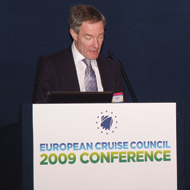
| European Cruise Council 2009 Conference Report
Tony Peisley reports on the European Cruise Council (ECC)’s annual Conference, which was held alongside the European Commission (EC)’s European Maritime Day event in Rome.
Dingle: A change in regulatory conditions is the only threat to European output.”
What
the cruise industry wants most from EU and EC politicians, bureaucrats
and lawmakers is “to be left alone to grow.”
This
was the unequivocal message from ECC chairman David Dingle.
At
the ECC annual conference in Rome in May, Dingle said: “We
are not looking for a load of money from the EU. All we need
to help us grow is enablement so all the stakeholders need to
understand the benefits.”
With
two ECC-commissioned economic impact studies (covering 2007
and 2008) published since the beginning of the year, Dingle
had plenty of ammunition with which to impress an EU audience
attracted by the decision to combine the ECC conference with
the EC’s own European Maritime Day event.
He
pointed out that the European cruise market was continuing to
outgrow North America’s and that, overall, “cruising’s
full ship business model remains a source of growth in uncertain
times.”
Since
2005, global cruise passengers have increased 12% but, within
that, Europe passenger numbers grew by 33% to 4.4m in 2008,
which was 10% up just on 2007.
Over
the same period, European cruise capacity increased 44% to 187,000
beds and helped attract a record number of people to Europe
from all over the world.
More
than 26.4m passengers embarked or called at European ports –
66% up on 2005. This contributed to the 71% increase to €14.2bn
in the industry’s direct benefit on the European economy.
Dingle
said: “Even landlocked EU states benefit because they
are selling manufactured goods and produce to the industry.”
They
will also have benefited from the 79% increase in European seafarers
since 2005 and the 66% increase to 311,000 in all jobs generated
or supported by the industry.
Cruise
passengers also spent €1.3bn in ports of call –
an average of €57 with the benefit from each ship call
now running at €100,000. For turnarounds, it is now €300,000
with each passenger spending €106.
In
fact, the €32.2bn total economic impact from cruising
was not far short of double 2005’s €19bn and it
pushed Europe ahead of North America in that respect.
Dingle
said: “Even if there is downward pressure on prices, growth
continues and the cruise industry will always deliver valuable
economic output. The only thing which would threaten this output
in Europe would be a change in regulatory conditions.”
In
a clear reference to the Alaska situation, he pointed out that
unfriendly legislation could result in ships being deployed
away from Europe.
“But
I would prefer not to contemplate this happening,” he
said, “because of the positive relationship which is developing
here in Europe between industry and regulators.
“We
need common sense over altruism in areas such as access for
the disabled and also the environment.
“We
want to engage in the whole debate about passenger rights, the
environment and infrastructure with questions to be answered
such as how a NOx-free area could really work and if EU sulphur
regulations should really exceed the MARPOL’s?”
Other
issues he highlighted included the upcoming 2010 review of the
1992 Package Travel regulations and the problem of individual
EU states imposing their own restrictive practices.
He
said: “We also need to ask if the indirect taxation of
supply of goods and services should be adjusted to recognise
global practices, while employment legislation should not be
allowed to damage the international competitiveness of EU states.”
He
also called for an international agreement at IMO level on carbon
market-based instruments.
Pointing
to the recent HELCOM agreement on waste water treatment ashore
in the Baltic as evidence of the industry’s intent, he
said: “We would obviously welcome any ‘Clean Ship
Initiative’ – every stakeholder would – but
we are running as fast as we can on technology advances.
“It
must be accepted that cruising is unique and highly valuable
– its size, its growth, the fact that it is not part of
anything else. Maybe it should sit in DG Mare in Brussels but
it must be liberated and – above all – left alone.
“It
is unlikely that European cruise tourism growth can continue
at its recent high rate but 10% annually is definitely achievable
and that would mean 10m cruises in Europe by 2020 for a total
economic impact of €60bn and 600,000 jobs.
“To
do that will require many more ships, so obviously we expect
orders to resume even if we cannot say exactly where and when.
“It
is also important to ensure that ports and destinations have
the infrastructure to cope but, with EU help, the cruise industry
can certainly deliver economic growth by promoting best practice
and global competitiveness.”
Antonini: “In a storm, some build walls while others build windmills to exploit the extra energy.”
The mood of the ECC conference was a mixture of long-term optimism resting somewhat uneasily alongside short-term caution and economic realism.
Not surprisingly, Fincantieri chairman Corrado Antonini fell into the cautious camp.
Pointing out that it was still difficult to know just how long the global recession was going to last, and therefore to be able to assess its impact on shipbuilding industry, he said: “The cruise industry has been growing at 7.4% since 1990 and we still have ships running 100% full, but there has been a definite slowdown in orders. There were 13 placed in 2006; 16 in 2007 but just three in 2008 and none so far this year.
“The concern is that skills could disappear if newbuilds do not come. About 80% of ships are built by subcontractors and these may go out of business or switch away from the sector if the work dries up.
“Cruising is in a good position to recover more quickly than other sectors but the financial
aspects are worrying, with banks very cautious on lending, making the securing of specialist financing much more challenging.
“But money has not gone away and cruising remains a good investment risk. It is also true that a down economy is when a good company can increase its market share. Cruises are opportunities in disguise. In a storm, some build walls while others build windmills to exploit the extra energy.”
This is an apt analogy given the technological developments being made in the face of environmental pressures.
He said: “Shipbuilders are becoming more efficient, streamlining their production, but they are also under heavy pressure and competition to deliver on safety and the environment.
“The Green approach now goes right through the shipbuilding process from design to build. Our final goal is ‘do not disturb the environment’ and, in this respect, the anti-noise technology being developed could be very important.”
At the time, in the middle of renegotiating two newbuild orders, MSC Cruises’ chief executive officer Pierfrancesco Vago agreed with Antonini about the financial squeeze. He said: “It is very difficult to raise money at the moment yet it has been the new ships which have driven growth.
“But prices were becoming over-inflated and, as the price of commodities goes down, I think the shipbuilders will make adjustments and the total cost will also come down.”
Silversea Cruises chairman Manfredi Lefebvre D’Ovidio was particularly downbeat about the current situation.
He said: “The capital requirements for growing a cruise line are huge and not all countries have export credit arrangements. Other industries also receive support for carbon-reducing measures but we do not.
“Running a cruise line is like doing ten jobs at the same time – we are managing ships, hotels, spas and entertainment centres while dealing with piracy, wars and diseases.
“On the positive side, demographics are in our favour with ageing populations in our main markets and new sources such as South America.
“For us, Europe is the largest destination with 40%-45% of our annual capacity there and it now provides 30% of our passengers, too.”
RCCL’s senior vice president international Michael Bayley held the most positive views for the European cruise industry.
Pointing out that, since 1997, land tourism had only grown 4.2% annually while the European cruise market had increased 10.6%, he said: “RCCL had just six ships in Europe as recently as 2004; this year, we have 21 here – and 70% of their berths are being filled by Europeans.
“By 2020, the number of European cruise passengers will have increased to more than 10m.”
Some of those will inevitably have disability issues and
a partner in the Marine Trade and Energy department of specialist marine lawyers Hill Dickinson, Maria Pittordis sounded a warning here.
She said: “We are currently making the case that, if cruise lines lose the right to refuse to carry certain disabled passengers, there will be safety issues.
Cruise lines carry thousands of disabled passengers every year but there are times when you can have too many wheelchairs on one cruise or a particular ship because it would make it impossible to meet the requirement to evacuate in 30 minutes.
It should be recognised that ships are not hotels so lines need to be able to refuse on the basis of health and safety.
If the passenger has a life-threatening condition – even if it is in remission – they will not have access to the full medical resources which would be available on land and they could die as a result.”
Verhoeven: “Ports do not usually put cruise ships at the top of their priority list because, simply in terms of direct revenues, they are not big providers.”
Praise and brickbats came in equal measure from ECC conference speakers for European ports and destinations’ approach to cruise tourism.
Costa Cruises president Giovanni Onorato said: “There is often a difference between what happens at chairman level and what happens locally.
“In too many places, there is a lack of collaboration between the port and other local authorities. We cannot homeport in certain ports because there are not enough flights coming into the nearest airport.
“There needs to be more co-ordination between seaports and airports but not all European countries recognise that we are in the leisure and entertainment business and that cruising is not simply transportation.
MSC Cruises CEO Pierfrancesco Vago had similar gripes. He said: “We found when we first took our newest ships into Genoa that the draft was not sufficient, so had to dock in a non-Schengen facility, not suitable for cruise passengers. This should have been avoided as the port knows the drafts of ships being built.
“Also, Greece is probably the number one cruise destination in the Mediterranean yet its ports still operate a first-come, first-served system for berths, so we could be bringing in a 3,000-passenger ship only to find that some ferry is in the berth we need.”
On the other hand, some ports and destinations are being genuinely innovative in the way they approach cruise tourism.
Onorato said: “At Savona, all the local policemen are being trained how to handle cruise passengers – what advice and help they need to give them.
“In Ancona, the local Chamber of Commerce is giving one free night pre or post-cruise to passengers while Izmir’ s Chamber of Commerce has softened the burden of passenger head taxes for cruise lines.”
Both Onorato and Vago welcomed the trend for ports to allow cruise lines to manage and operate their own terminals.
European Sea Ports Organisation secretary general Patrick Verhoeven said: “Ports do not usually put cruise ships at the top of their priority list because, simply in terms of direct revenues, they are not big providers.
“But cruising is very important in terms of developing the port:city relationship which is seen as increasingly important.”
The president of the Port of Venice, Paolo Costa, said it was important to put cruising into the context of the whole port and destination operation.
“You have to look at net gains, he said. In Venice, cruising is important but not so important, for it is less than 2m out of 20m tourists. Also, there is a shadow cost as we have to close off the canal to other activities when ships come through, thereby losing some other revenues.
“So ours will be a different approach to a place where cruise is the no.1 tourism sector.”
The differences between different cruise – or cruise-aspirational – ports will be addressed in the EC study currently underway which aims to help ports judge if, when and how they should invest in cruise-friendly infrastructure developments.
Head of DG Mare’s maritime policy development and coordination Paul Nemitz said: “We studied employment trends in all sectors related to the sea and the top three were energy, shipping and coastal/maritime tourism.
“So the next stage in this study on tourism facilities in ports is to find out how to increase economic benefit and job creation from cruise tourism while reducing negative environmental effects.
“We also want to help smaller communities understand the cost-return and environmental effect of investing in such infrastructure and provide them with an indicator to clarify that return on investment.”
RCCL’s vice president commercial development John Tercek pointed out that “there is no proven formula for public/private development of ports, but my view is that investment for the benefit of all shipping – eg. dredging, extending berths etc. – should be the responsibility of local, federal or even EU funding but smaller, more passenger-facing facilities are best left to the private sector.
Borg: “I am optimistic that we will soon get the required impetus for investments to make shoreside electricity a reality in many ports.”
The EC seems determined to push forward with the installation of shore power facilities for cruise (and other) ship utilisation across Europe.
This was made clear at the ECC conference by EC commissioner for maritime affairs and fisheries Joe Borg who said: “I am optimistic that we will soon get the required impetus for investments to make shoreside electricity a reality in many ports, including in neighbouring countries in the southern Mediterranean.
“The relevant standardisation bodies are close to an agreed standard for the ship-to-shore connections.”
Maritime policy development and coordination unit head Paul Nemitz also revealed that shore power would be zero-rated for VAT.
Their enthusiasm, though, flies in the face of increasing evidence of opposition from shipping and ports to the shore power concept, based on the high cost involved for what is increasingly believed to be a flawed view of the potential environmental benefit.
Also speaking in Rome, Carnival Corporation Plc’s vice president policy and regulation Tom Strang said: “We really need a long-term pricing viability study and overall assessment of cold ironing (shore power)’s potential positive environmental contribution.
RCCL’s global chief environmental officer Jamie Sweeting agreed: “There are many unresolved issues with shore power. The amount of power required means it will often require a new substation to be built at the port and this can cost $45m.
Then there is the whole issue of where the shore power is coming from – is it cleaner than the ship’s own power source?”
There appears to be more agreement on other industry and environmental issues. Commissioner Borg said: “Cruise tourism is helping economic growth the length and breadth of Europe – a genuine maritime continent.
“We can proudly champion the importance of cruising to Europe’s maritime activities, as it provides work for shipbuilders, marine equipment producers, employment in ports, coastal communities and the wider regions and valuable economic benefits all round.
“We need to build on this and remove the remaining obstacles in order to integrate cruising with regional tourism in the best possible way.
“The other challenges include environmental protection... while cruise tourism grows, environmental impacts must be kept to a minimum, which is why cruise tourism in polar waters must be addressed.
“But today’s cruise lines are pushing the boundaries of different technologies, with shipbuilders also innovating.
“There is an opportunity for Europe to emerge after the downturn with a new class of environmentally-friendly ships.
The Commission is planning a Clean Ship Initiative, which will not just apply to cruise vessels.
Strang said: “Our passengers increasingly demand that we operate to a higher environmental standard. As the ECC, we produced a mission statement at the end of 2008 which committed us to developing a sustainable cruise industry.
“We committed to improving energy efficiency, reducing waste and increasing recycling.
“We believe the role of the EC is to help IMO achieve its goals through a rigorous and harmonised approach to rule enforcement.
“On sulphur, an international solution is vital and we do not believe a unilateral EU move is necessary.”
He also said the jury was out as regards the benefits of hull scrubbing. “It is not yet viable and, in any case, there are issues as to whether there could even be a negative environmental impact because of the materials used for scrubbing.”
Sweeting said: “We believe in reducing, reusing and recycling but it can be frustrating when we separate solid waste on board, send it ashore and see it all slung in same landfill.
“In retrofitting, we are doing simple but costly things like grinding down the welds on hulls before the paint goes on to reduce drag and therefore fuel consumption.
“Recapturing heat from engines and incinerators is a major area as we can make fresh water through reverse osmosis using heat recapture.
“The ECC is also adopting CLIA policies on waste-water management which are way ahead of regulatory requirements.
“But we need more support to continue to find the technological solutions to environmental questions. We have to fund the innovators to find the ocean-going solutions.
“To put this into perspective, among ECC member lines we have 300-400 people working 100% flat out on environmental stewardship. DG Environment at the EU has just six.”
As an indication of how much progress the cruise industry has made, Meyer Werft’s head of sales and design Thomas Weigend pointed out that airlines still use the B737 platform first created in 1969 for new aircraft.
He said: “In our business, we could not contemplate using the same platform from more than ten years ago and a lot of our innovation results in lower energy use.”
“In the future, I can see cruise ships powered by LNG and LPG and – by 2025 – fuel cells will also be used to power certain areas of the ship’s operation.
|